Transcript
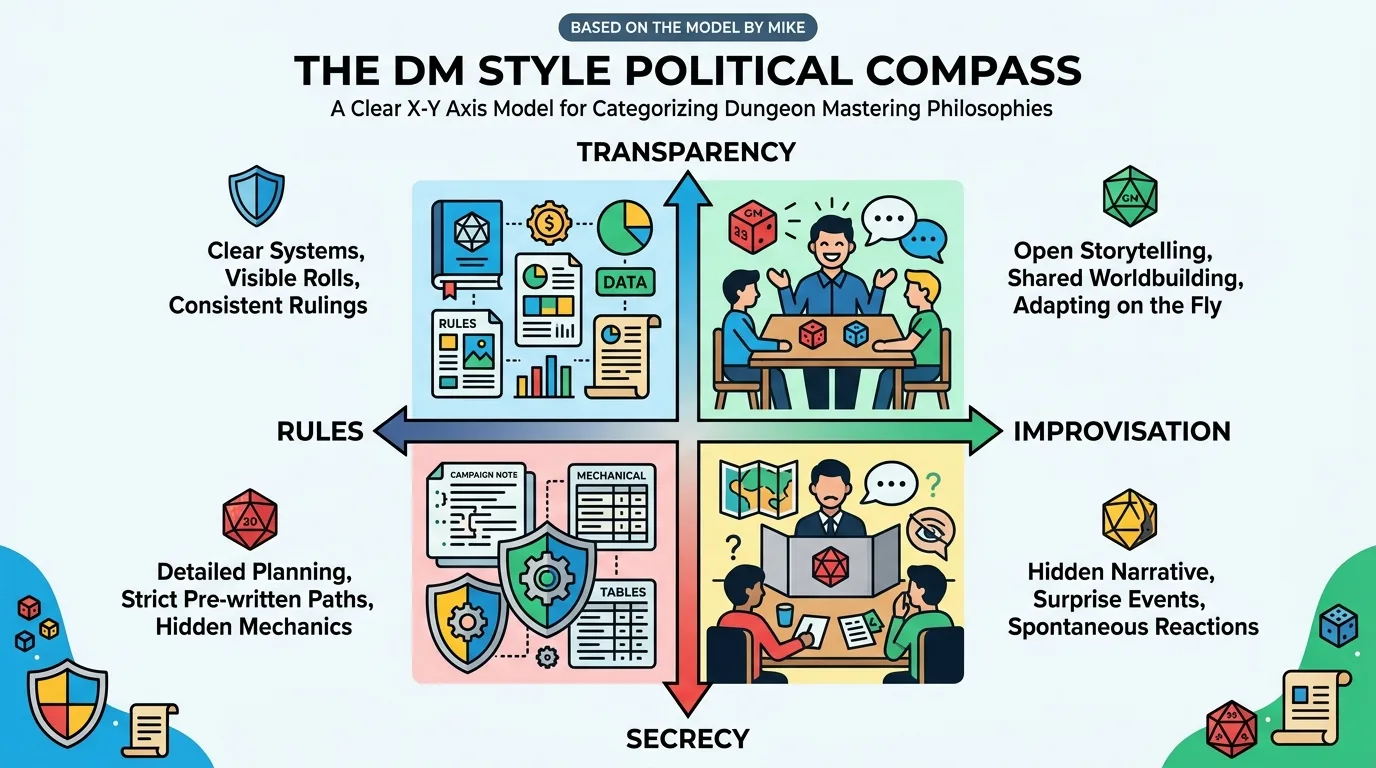
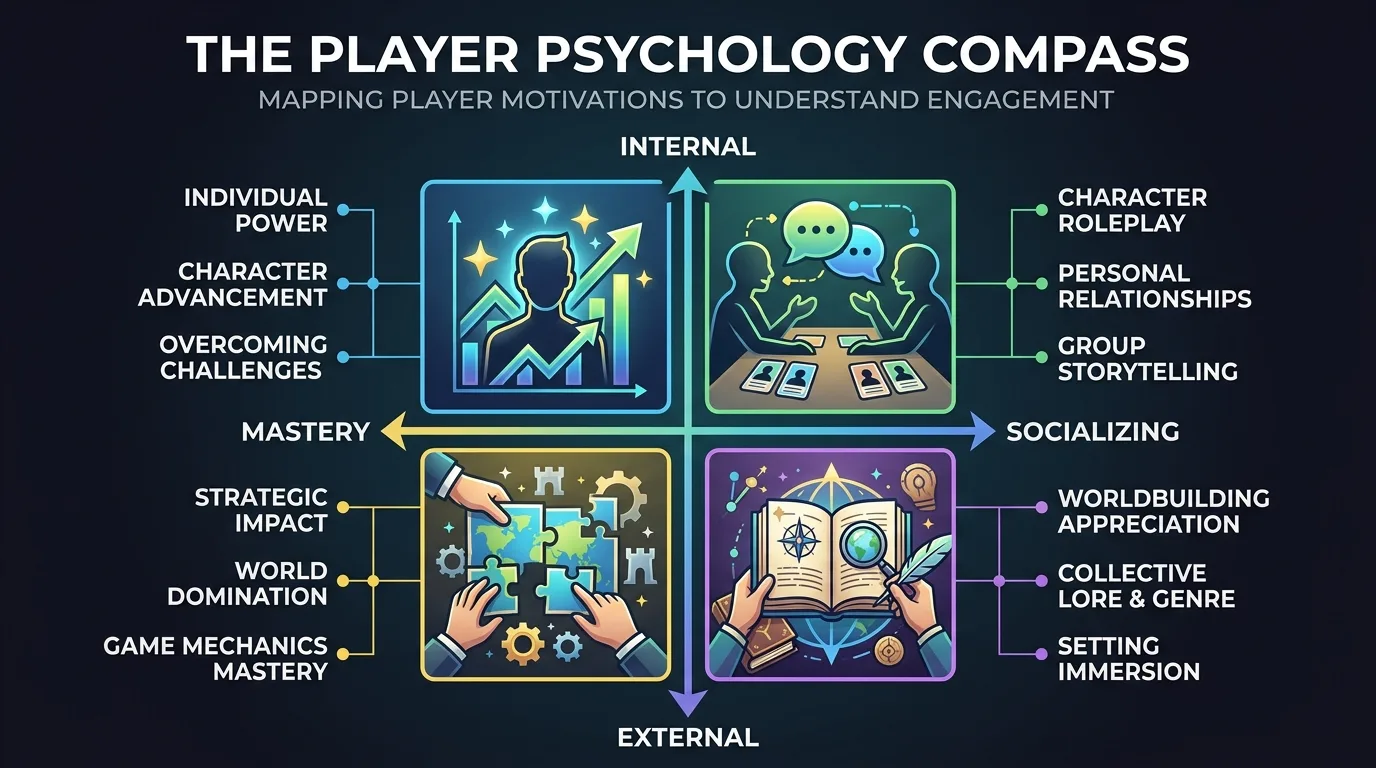
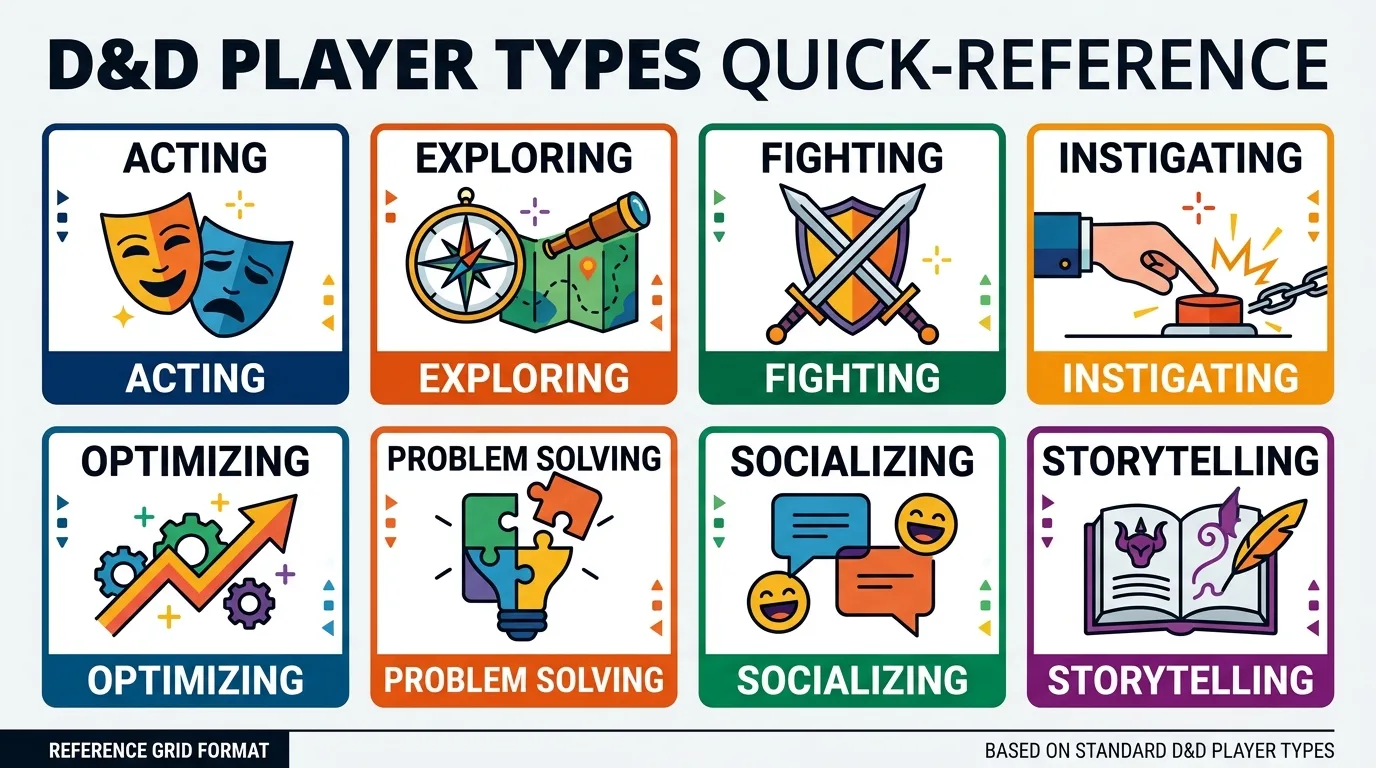
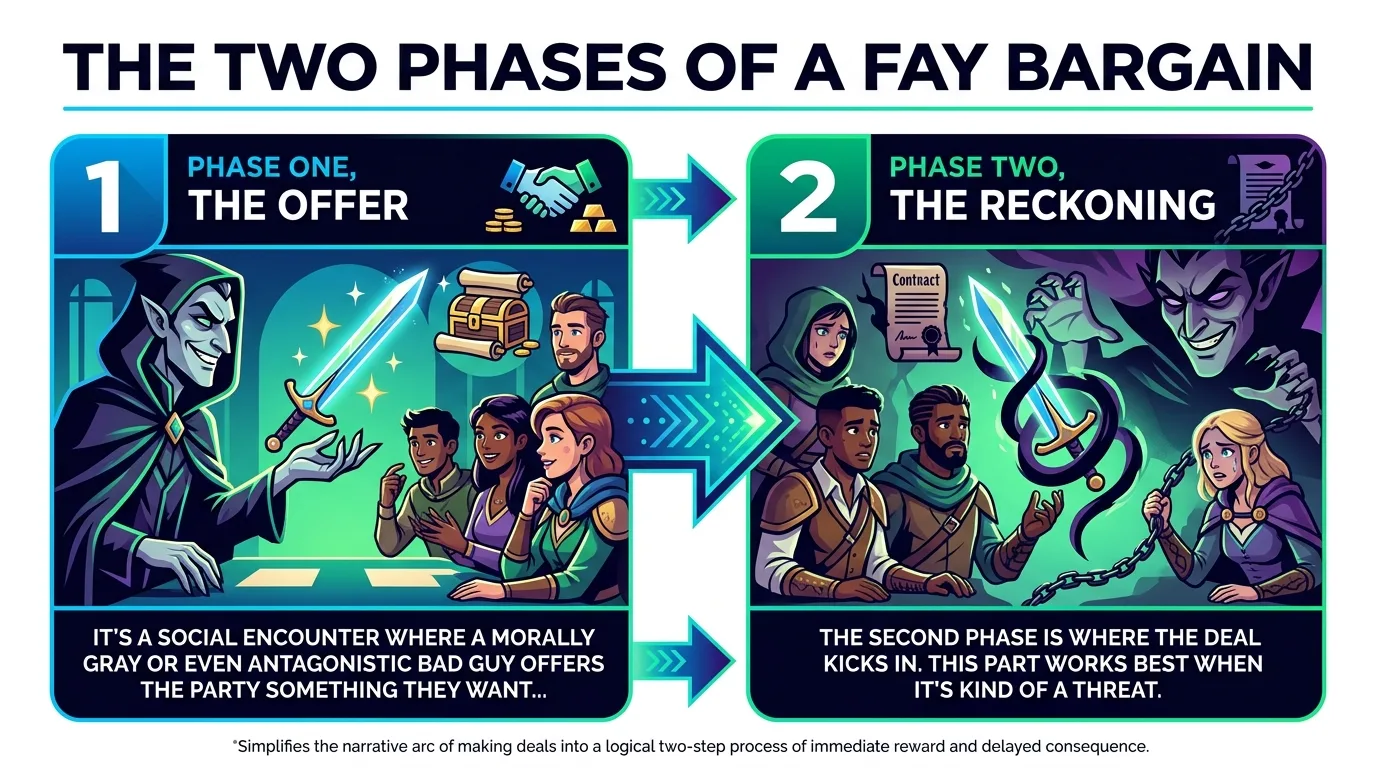
Listen close and listen well. You face wicked evil down in hell. Off to face the vile Gore moth. To me you come like flame draws moth. Drink this here magic brew and within minutes he'll be slew. >> Slooh. >> Yeah, like sleigh. >> You mean slain. >> Do you take the brew? >> All right, Hagman. Why are you helping us? >> In return for this brew, you will give me access to his horde. There is an item there I desire greatly. No rhyming. >> Do you take the deal? >> No. I think we could take Gourmoth by ourselves. There's no need to divide the loot. >> All right, worth a shot. Why is it that the players never take the hag's bargain? It's such a fun trope, but I rarely see players engage with it. It's a common complaint for DMs that they'll create these bargains, but the players never bite. Why is that? I think it comes down to player psychology. Welcome to Mystic Arts, where I keep finding new ways to go the extra mile. And this week, it's a little bit on the nose. My name is D. I'm a professional writer and director and I've been DMing for over a decade. The Ascent Into a Verness has a section dedicated to what happens when your players go down in combat and how they could make a deal with the devil. There are countless fantasy stories about characters making bargains. It's kind of a staple of the genre. This video is a part of Monster Week, an annual TTRPG community creator event organized by Jenny D and Poy Hat. This year, all your favorite creators are talking about the Faye. There's a playlist in the description, so for more on Fay week, go check it out. So, for the purpose of this video, forget what I just talked about and deals with devils for a second and let's talk about making deals with hags because there are countless fantasy stories about fa bargains. Hell, I think one of the most memorable stories in popular Dn D is about a deal with the hag >> that was sprinkled with the dust of deliciousness. >> That's right. Who could forget the time Jester on Critical Role fooled a hag with a really tasty cupcake? I mean, I'd be defeated by a really tasty cupcake, too. If you haven't watched Mighty N in campaign 2 of Critical Role, I mean, I get it. I think it's 550 hours of content, and the animated show hasn't covered it yet, so I'll give a quick overview on the story. If you don't want spoilers, mute until I wave back at you. We learn that not the Goblin was born as a halfling, and she was made out of a bargain with a hag to save her family. In return, she was turned into a goblin. When the Mighty Nine found this hag, Jester, the party's cleric, sprinkled some dust of deliciousness on a cupcake, which by the DM's own rules gives whoever eats it disadvantage on wisdom ability checks and wisdom saving throws. So, Jester cast modify memory and change the Hag's memory to make her believe that she agreed to remove the curse. Brilliant. Okay, we're back. No spoilers from here on out. I'll add one thing though for context, but it isn't a spoiler. It's important to acknowledge the fact that in that clip, the character who was saved from a fake bargain, didn't actually make the bargain at the table. Sam Regal, who plays not, made the fate bargain in his backstory, and then the bargain was resolved at the table through heroism and wit. And I think that's maybe the most important lesson of this whole video. Not about making bargains only in your backstory, but about resolving bargains. But we'll get back to that. If you're anything like me, you've tried to offer your players a deal and they're not into it. You've set up the situation, introduced the hag with the bargain of a lifetime, and the players say no. A devil comes along and offers the players an automatic victory in the next fight, and they don't want it. A hag offers immortality in return for something cheap, like a firstborn, and the players say, "Hell no." They don't consider it for a moment. Even just a morally gray NPC offers to help the players unconditionally because doing so benefits both the players and the morally gray NPC. Maybe someone who belongs to a faction that the players aren't opposed to but don't particularly like either, but even then they say no. Why is that? Well, I don't know. I decided to start writing this video before I had an answer. And oh my god, the weather outside is gorgeous. Let's go for a walk and see if we can't work out the answer. Come along. I don't know if it's possible to talk about tempting players without first talking about player psychology and what plays into it. I posted a video talking about DM styles in response to another video about DM styles by Matt Kovville. And as soon as I posted that video, I got sent, I think 2 hours later, a graph from Mike Merles, the designer of fifth edition Dn D. You know, thinking about it, maybe we should venture into the bog. Oh god. Oh jeez, I regret it. The response Mike sent over was a political compass, one that tracked DM styles as an axis from top to bottom and left to right, much like you do with politics. In politics, on the top is authoritarian, on the bottom is libertarian, and then you have the economic right and the economic left. Mike however wanted to track DM styles in terms of at the top there is transparency on the bottom secrecy on the right hand side of the table meanwhile you've got improvisation whereas on the other side you have rules he sent over this chart and I said I don't know I still feel like I'd have a hard time charting myself on this course it had these quadrants for different styles of play what kind of games that dungeon master would prefer to run in the bottom left with most rules interpretation and the most secrecy is kind of a classic dungeon crawler style game where you're exploring through secrets and you're doing it in accordance with the rules because you want it all to be fair. That quadrant would squarely belong to OSR style games. Even games run in fifth edition that are run in that sort of OSR style would belong in that quadrant. Above it, you've got tactics and tactical style play with these sort of big heroic fights. The transparency is maximal because you want to be making the right tactical choices at any given time, but the rules are heavy. If this were an RPG system, it'd be something closer to Draw Steel or Pathfinder. Meanwhile, as we travel across the compass over to the other side, you've got games that rely more on improv and collective storytelling. Depending on your point of view, you could chart other games such as PBTA or whatever into those two quadrants. But that's DM styles. So, what exactly is player styles and where do they fit in? How do we use this knowledge to tempt our players? Well, we'd need a similar language for players. There already exists a list of players from the early days of the hobby, but maybe this kind of compass would be more helpful. I'm not sure. I still haven't changed my mind on DM styles if I'm honest. I think the axis grid is great. I think it's an informative way to think about things, and I think it gives us a language to talk about DM styles, maybe even gives us the language to describe some dungeon masters down to a T. But I still don't feel represented by that compass. I want to be max and everything, but on an accessbased chart, that just means I'm an enlightened centrist. Gh. But having language for stuff like DM tools, tools like Mike Merles's Compass, can help us think about the game we want to run, think about where we are on the grid, or maybe just where on the grid we want our next campaign to be. We, the community, still haven't come to a consensus on DM styles, but I'm thinking, I wish there was a compass like this for players. What kind of players are there? And how would it look on a compass? I decided I needed to ask Mike Merles what he thought about player styles and if that could also be charted on some kind of political axis like he did with DM styles. Well, before I managed to ask Mike about any of that, he sent another chart. That chart leaves the quadrants the same kind of games, but it's for players and what players tend to prefer those styles of game. So for example, if you are a kind of player who loves the idea of a rulesheavy, secrecyheavy game, you might be the kind of external mastery type of player. Your narration style is external, meaning you tend to think of you, not your character. What you want to do in the game is reflective of who you are as a person, and it's reflective of what you like to do as a person in your fantasy. If your character dies, no big deal. You'll just make another character. And the thing you engage with the most is mastery over socializing. You like the idea of mastering the rules, building good character builds, having an awesome time, being a powerful character. In that quadrant, you'd be perfectly happy playing something a bit more OSR style. On the other side of the spectrum, we've got socializing. Are you showing up to the table because you want to master your rules, or are you socializing? Are you here because you want to hang out with your friends and have a good time? Are you the kind of player that would have a better time if there was romance and kissing? Do you tend to have the most fun when you're laughing, playing, you know, funny characters or characters who are kind of intrinsically silly? If that's you, then you're probably more on the socializing side. Then there's the difference between external and internal. How much do you live inside your character's head? Nothing breaks the flow of a game, like clunky audio setup. Storytelling should feel effortless and not distracted by tech. Pocket Bard, the sponsor of this week's video, keeps you present, confident, and ready for moments that matter most. Pocketbard is a music and soundsscape companion app helping make game masters lives easier. With PocketBard, game masters can prep less and play more. Weave immersion into your games by using the interactive audio that's accessible, intuitive, and responsive. But even just grabbing it for free and trying it out, you might discover it's amazing. It seamlessly transitions between exploration and combat from scene to scene. There are no like harsh breaks. I, for one, I build playlists for all of my music at my table. And sometimes I am having to skip a song or I'm having to tweak the music or the volume or whatever, and then I have to fade one track in, fade one track out. Pocket Bar does all of that. When you switch to combat, it layers on a combat track with immediate beats while it plays down the other stuff. So, you just click a button, swap to this track, and the app does the rest of the work for you. So, go find Pocket Bar on the app store and make your DMing easier. I kind of like this compass idea, but again, I'm not sold. We might need both DM styles and player styles to have a third axis for investment. At the bottom of the tier is not engaged, and at the top is very engaged with again the vast majority of players somewhere around the center point. Honestly, we need that for regular political compasses. Words like external versus internal are also a little confusing because at first I assumed it meant first person or third person which isn't a terribly useful metric. More of a symptom of what could be interpreted as player style sometimes. Merles explained to me that he meant internal for focused on the personal experience of a character whereas external was focused on the collective experience of the setting, world or genre. I think that tracks. I definitely have players who are thinking more about their character versus the ones who are thinking about the Melu. Some of my players are incredibly happy to play fairly standard characters just to go visit parts of my setting or any setting. Whereas other players want to know what the setting can do for them, what kind of questions it asks about them. And that got me thinking about knife theory again. In our video last week, I talked about two different characters I played, Lee and Walter. With Lee, I had given the DM a bunch of knives. I had created this idea of a person and then that person had thoughts independent of my own. When I was roleplaying as Lee, I was Lee. I was having Lee's thoughts. That is a very internal character. I hadn't thought of a big build for him. So, I think he belongs squarely in that upper right hand side quadrant. High socializing, high internal. When I was playing as Walter in West Marches, I wanted to get the OSR experience. And I was playing a West Marches game. If Walter had died, I would have found another character to play and I would have had a great time with it. So, he belongs in that bottom quadrant, but I was always viewing him as a writer. I tend to think of an external play style as the play style of a writer. What is next for this character and his story? Whereas, when I'm playing an internal character, I tend to think of it in terms of who am I? Who is this person? What do they want? How do they feel? I don't know. But, but I get into that headsp space where I would find out. You know, it was winter 2 weeks ago and now the sun is out and the first day of summer is I think next week. Fantastic day to be in Iceland. Really, really beautiful. We just have two seasons in this country. Winter and summer. And that seems ridiculous every year. And then around the first day of summer, I am reminded why we only have two seasons. Here's an industrial marina. And then right behind me is okay. Damn, the walk started to distract me. Let's get back on track. Player psychology. We're talking about tempting your players. So, let's take this to the history corner. What's important to remember about all these terms, the political compass I just showed you, is that they are built on terms that have been with us since the dawn of the hobby. The list of contributors to all of this language that now exists is endless. Thornton, Pulsiver, Blackout, it just goes on. Playing at the World has an excellent article on summarizing the history of this lingo. As early as 1971, Steven Thornton wrote, "There are at least three types of war gamers. Fun war gamers who play just for enjoyment and like non-complex, unambiguous rules that are quick to use. Perhaps not totally realistic, but fun. Second are simulators who try to reenact battle conditions to the nth degree, but enjoy the game and the playing. Thirdly, there are the competitors, the odd ones out. They only play to win. invariably wrangling over the rules and using complex rules to cover the fact that they will attempt to cheat in order to win. That's a hot take from 1971. We have always been talking about player types. Even the idea of charting them on a political compass is a new look at this compass that appears in the elusive shift. The now popularized list of players comes from Robin Laws and it has since appeared in the Matt Kovville video and all across the hobby. I think it's sort of the definitive list. It was even added to various dungeon master guides throughout the ages from third edition onwards. Though oddly, the 2024 DMG doesn't credit Robin Laws for some reason. I tend to think of the list of player types as being basically the one that appears in the DMG. These are honestly a great way to learn on how to think about your players at the table. They each come with a little bullet list on how to engage those players. Look, acting. Players who enjoy acting like to embody their characters personalities, perspectives, and attributes. Engage these players by giving them opportunities to develop their characters, personalities, and backgrounds. Allow them to interact regularly with NPCs. They might get a huge kick out of the part where they negotiate with the hag. On getting to speak in character to the hag exploring, players who desire exploration want to experience the wonders that a fantasy world has to offer. Again, they would just be excited to see a hag. Drop clues about hints of things yet to come. Let them find things when they take the time to explore, providing evocative descriptions of exciting environments. Exploratory players might really enjoy the opportunity to piece the puzzles together. How do these things all fit in? If we go engage with a hag, what next? What happens here? yada yada. Fighting. They want to fight the hag. That makes sense to me. At some point, if you're making a bargain with a hag, I think you should fight the hag. I think that just makes perfect sense. Instigating. Players who like to instigate action are eager to make things happen, even if that means taking perilous risks. Players want to have agency and instigator above all wants to be able to drive the plot to a point they like. Optimizing classic people want to make their character builds. They want to get the cool magic items. They might really enjoy getting the the potion that makes them better at fighting Gormoth. Problem solving. Again, we have this sort of puzzle thing. They might scrutinize NPC motivations. Question. Why should we make a deal with the hag? What's the hag getting out of this? They want to interrogate them. During the part where they're negotiating about a deal, a problem-solving player would try and find out what all the different parts of the deal are. Think those things through and let those players be able to renegotiate the terms. Let them be able to change the conditions of the deal. Socializing. Many groups include players who come to the game primarily because they enjoy the social event and they want to spend time with their friends, not because they're especially invested in any part of the actual game. Don't try to force these players to be more involved. Maybe you drop a deal with a hag on the table and there is a player or two or three or however many. They just are going to wait and see what happens. These are sort of audience members and there's nothing wrong with that. If they're having fun, no big deal. Eventually, maybe they'll come out of their shell or maybe not. Maybe they're just having a good time. Storytelling. Players who love storytelling want to contribute to a narrative. They like it when their characters are heavily involved in an unfolding story and they enjoy encounters that are tied to and expand an overarching plot. These are probably your in with the players. These are the ones who might want to go take, you know, a shot to the knee in order to get some kind of benefit. They might want to hurt themselves in order to gain something because that's a good story. This is the group that you you you probably have an easiest time with. And when you're looking at a list of players like this, socializers, problem solvers, optimizers, instigators, fighters, explorers, and actors, these are all things that they like, which means that you can use them to tempt them with the things they like. Hey, this hag, this is a story line. If you make a deal with her, she'll come back. She'll continue to make deals with you. She'll return frequently. Explorers and problem solvers might get more of a kick out of just the puzzle element. Is this deal worth it? Can we change this one condition? All of those things are perfectly valid ways to play. And when you start to notice types like this, you start to notice them everywhere. And you start to be able to use them to make sure that your players are having fun at your table. So, we've got these labels. How are we going to use them to make sure that our players are ready to get tempted by someone like a hag? Doesn't have to be a hag. Could be a fiend. Could be an NPC that just wants something that the players probably don't want to give up. You can use the same idea no matter what. There's a person up there that's dangerous. Well, I think these kind of labels, both the compass that Mike Merl sent over, but also just the idea of the categories of what kind of players there are. The minmaxer, the buttkicker, the mad scientist. I think if you play into those types, that's how you tempt them. Ooh, ducks. And there are loads of ways to think about it, and you probably just need to figure out how to get to that player. There's no one guaranteed way to make sure it works. I have a few tips, but that is basically it. You have to make sure that whatever you're doing is the kind of thing that that player would likely engage with. So, say, for example, that you have a power gamer. They maybe live in that lower quadrant of the player scale. Well, reward that part of the game. A bargain by its nature is something good and something bad. So, if you make the good live in the quadrant that they like living in, they're more likely to accept it. They're more likely to think, you know, that's probably good for me. I like that thing. I'm a power gamer and this is a plus two sword. I'd love a plus two sword. That sounds good. I might be able to take a little bit of narrative punishment for it. Or if it's a narrative player, vice versa. you can get the story beat, but there might be a mechanical trade-off. But the more I thought about that, the more I was like, I don't know if that's fun. I I kind of want those two things to exist in the same area. Either the bargain has a mechanical boon and a mechanical drawback, or it has a narrative boon with a narrative drawback. At which point, I think what's most important is that A, the players feel desperate. If they're not desperate, they're never going to take the deal. And B, they have to know what the deal is. If you have a hag, tell them, "I will give you this reward, but in return, I want an item." Well, the players instinctively go, "What's the item?" An item surely has mechanical benefits. It's a magical item. We can identify it. Maybe we find it, we identify it, we see what it is before we decide whether or not to give it to the hack. I think that's fine. From the player's point of view, if they're getting into a bargain, they're going to want to be able to play with the bargain. They don't want to write it in stone, and I don't think they should. I think you should just be prepared as the DM to meet their shenanigans with your own shenanigans. I remember when playing Odyssey of the Dragon Lords, when we entered the final dungeon of the campaign, the DM introduced a hag to the table. She offered to tell us the inside layout of the entire dungeon, how to navigate the maze and what the factions were and how we could use them to our advantage. In return, she just wanted one item, a skull. We didn't agree to the deal. We just fought and killed the hag. And I think that's because we weren't desperate. We didn't need to make the deal. We were basically full on hit points and had spell slots to spare. There was no reason for us to take the deal other than just to give it a go. What the hag didn't say is that this was the skull of Belitria, the skull of a dragon that our party owed a lot to lurwise and one of the players was a dragon rider and they knew Belitria. So, it was personal for that player and the skull could cast wish. A fat chance we would have taken her up on it. But let's say we did. We agreed the deal and we got all the information and then eventually we found the skull and we simply refused to hand it over. Then the hag would have tried to kill us and then it's back to fairly normal D and D. Time to fight a hag. What could the DM have done differently? Well, he could have made sure that we were low on resources and desperate to avoid the conflict when the hag offered us the deal and then made sure that the hag didn't come to claim her reward until the next time we were low on resources. That way, we would have been afraid of the hag both times. But that's not enough. By definition, if we'd made the deal, had to be strong enough to make it be a punishment if we break the deal because when you make a bargain with your players, they're going to break it. And that's not a problem. That is kind of the game that you're promising. I don't think anybody's fantasy world includes them getting absolutely screwed over by a deal they made with the devil. They want to make the deal with the devil and then win. Which I guess means that you need good stat blocks because if the hag inevitably is going to get screwed over by the players, the hag is going to want to attack them. And hey, that's what most of the game is about. It's about combat, right? It's just a different way to set the stakes. The more I think about it, the more I think that is what a deal is. It's a way to change the conditions of the test, to set the stakes of the combat differently. If we'd been desperate with that hag and if we'd known that a wish was on the table and the deal we thought was still good enough that we'd take it and then we tried to weasel out of it that better have been in one scary hag. One that could have challenged the whole party and one that would have only chosen to challenge the whole party once we were low on resources once we were scared. Once we were in a desperate spot because then when the hag shows up and says hey it's time to pay up. We might have paid up to avoid the deal which I guess means a deal doesn't have one phase. The deal has two phases. Both phases come with their own challenges. Phase one, the offer. The first phase of a fay bargain is the offer. It's a social encounter where a morally gray or even antagonistic bad guy offers the party something they want in return for some kind of curse. Maybe it's a mechanical curse like the spell bestow curse or a permanent level of exhaustion. Maybe it's a blank favor that the hag will claim down the line. Maybe it's something in the story with no mechanical flaws, like a firstborn child or their joy or happiness. In Wild Beyond the Witch Light, all the players start the adventure with no memory of how they lost something dear to them. But they learn over the course of this adventure that it was taken by Hags in the Fay Wild. It could be their smile, their heart, their bravery, their reflection, their brother, whatever. I personally like the get something now, get a favor later variant because I like being able to kick the can down the road. I often don't know what the deal is just yet, but I'd love time to figure it out. Here's the secret with the offer. You want to make it as easy to agree as possible. This is also true in business because you know the other shoe won't drop until phase two. So, just make the deal easy to accept, as easy as you can make it. In my industrialized flintlock fantasy game, I had a wealthy billionaire offer the party a check of 100 million imperial banknotes in return for seemingly nothing. They don't know what strings are attached. The billionaire said there were none, but they haven't cast a check because they're afraid of whatever reckoning that may bring. But now they're carrying this check around, having not made a decision themselves. Maybe that middle stage will have its own consequences. I don't know. I just like introducing Tetris pieces that either fall into place or I put them aside for phase two, the reckoning. The second phase is where the deal kicks in. You could do phase one and two at the same time, but in my experience, that leads to players just refusing the deal outright. There is something potent about being punished immediately that humans understand deep in our monkey brains. We only have to touch the hot stove once. But taking on a win now, even though we know it's going to suck later, that's something us monkeys never learned. We procrastinate, develop addictions, and generally punish ourselves in slow ways all the time. Do that to your players. Reward now, I promise all the suck happens later. Maybe even when the campaign finishes. Phase two is whenever the hag claims their part of the bargain. Okay, I helped you. Now give me what I am owed. This part works best when it's kind of a threat. I mentioned this earlier, but the thing is the players will probably say no. They'll want to test their luck, fight the hag, weasle out of the deal. Let them. Nobody's playing a fantasy game where they lose repeatedly. They want to make a deal, reap the benefits, and then win. And if you're already typing up a comment about how players will never learn doing that, I got to say, you're not their teacher or their mommy. You're there to run a fun fantasy game. Let them try to weasel out of their deals to win out over their fantasy version of procrastination, addiction, and whatever else this bargain serves as a standin for. Make the fight hard, maybe even very deadly, but don't crush their hopes and dreams because you think that's the lesson they need to learn. Let it be fun, heroic, and exciting. And if you do that even just once, your players will be more likely to make bargains again in the future. That's the biggest takeaway from this video, to be honest. If you like the idea of dealmaking fay, then don't screw your players for making deals or they will never make deals ever again. It is a give and take. It could be that a deal gone wrong and fighting the hag in this example might still result in a TPK, or maybe just a few deaths as a treat, or maybe one death and a retreat. Maybe they win against the hag, but now the boss fight is harder because they spent resources on an optional fight they could have avoided. That's okay. I'm not saying make all deals meaningless. Just make sure it's still a game with informed choices where dramatic decisions have mechanical impact. That's what RPGs do better than any other medium. This is a lot easier to do in D and D with devils because there's a bunch of highlevel arch devils. But what if there was a bunch of different cool arch fay? For the last few months, I've been making a bunch of fay creatures, specifically goblinoids, goblins, bug bears, and hobgoblins. I compiled them all into one PDF to stick on my Patreon, which is uh linked in the description. And in the bottom of that post, in the back of the PDF, I decided to stick a bunch of CR20 plus archfe like Fenrris the Wolf Titan, Hob the OneEyed Goblin, the Winter Prince, and perfect for this week's video, Baba Yaga, the mother of all hags. If you want to make sure that your players think twice before screwing over a hag, make the hag be really, really scary. Just use Baba Yaga. She's the mother of all hags. Hags or devils, it doesn't matter. Both phases need to find the players down in the dumps. Happy people don't make fa bargains. Remember the cupcake example from earlier? Not the brave was not in a happy place when she made that bargain. Bargains start with desperation. Someone promises to solve your problems. So, go chase your players up a tree and then give them the hope they'll be able to get themselves out later. Because more than anything, players want to win. That is kind of the secret of making deals with hags. One final consideration for you. I think you should make sure that this is something your players want. There are many times where you're trying to do something cuz you think it's going to be cool and your players just aren't into it. If you think it's really cool to give the players opportunities to make deals that hurt them in the end, your players might not like that. They might love it. I, for one, am the kind of player that loves to have my character lose an arm or a leg or something in the dungeon. But that's not for everybody. A lot of ink gets spilled on whether or not this is the kind of thing you talk to your players about. And yeah, I think that's a part of it. I think if you're running this into a furnace, I think it behooves you to make sure that your players like the idea of spending all of their time in hell and everything that comes with that, including dealmaking devils. Same with the Fay Wild and dealing with hags. But also, if you try it and they're not into it, maybe there's nothing else you can really do about that. Maybe that's just how it is. Just make sure to ask yourself these questions. >> One, victory. Are the players able to win? What does it look like if they weasel out of the deal? Do you have a stat block ready? Two, play style. Are you making an appeal to the player's favorite play style? Use the compass or the list of player types to find out how to lean into their play style and make a deal that appeals to them. Three, desperation. Is the deal meeting the players while they're desperate enough to take something that promises to punish them in the future for a reward now? Four, appeal. Is this the kind of fantasy your group would engage with? Do you have players who like the idea of playing with morality, bargains, hags, and fairy logic? If you got a good answer on all four, I think you'll be able to trick your players into making a deal as long as you're ready to get tricked in return when they try to turn it around in phase two. As the GM, it's your job to lose gracefully. Start small, maybe with a little less meaningful deals, and then scale up as the players level up. And eventually you'll be making these deals up on the spot and tempt your players into the craziest bargains made by the most insane hags. That sounds like a great time to me. And that's where we'll pick it up next time. This channel is run by me and my girlfriend. >> Just take all these books. >> Oh, okay. This video is sponsored by Pocket Bart. Link in description. And if you're feeling especially generous, go watch the rest of today's FA week playlist and spread the love to the wider community of RPG YouTubers who are all making videos about Fay this week. And until next time, keep studying the mystic arts.
This video helps Game Masters design tempting bargains (with hags, devils, or fey) that players actually accept. It breaks down player psychology, provides a two-phase structure for deals, and offers a checklist to ensure these narrative high-stakes moments enhance the game rather than punishing the players unfairly.
Worksheet: Mastering the TTRPG Bargain
Understanding Your Players
Before offering a deal, identify what drives your players using the "Player Style Compass" and Robin Laws’ player types.
- Identify the Player's Focus:
- Mastery (External): Wants to master rules, build powerful characters, and win.
- Socializing: Enjoys the shared social event and laughing with friends.
- Internal Experience: Deeply immersed in the character's personal feelings and thoughts.
- External Experience: Views the game like a writer, focusing on the setting and the "big picture" story.
- Identify the Engagement Type:
- Actors: Offer a chance to develop personality or interact with NPCs.
- Explorers: Offer secrets, clues about the future, or evocative environments.
- Fighters: Ensure the bargain eventually leads to an epic, high-stakes combat.
- Instigators: Give them a way to drive the plot or take a big, perilous risk.
- Optimizers: Offer mechanical boons, like a +2 sword or a unique combat potion.
- Problem Solvers: Allow them to interrogate the NPC and renegotiate the terms of the deal.
- Storytellers: Offer a "shot to the knee" (narrative setback) in exchange for a compelling story arc.
Phase 1: The Offer (The Setup)
The goal of the first phase is to make the deal as easy to accept as possible.
- Create Desperation: Don't offer deals to "happy" or full-health parties. Wait until they are low on resources or "chased up a tree."
- Make it Easy to Agree: In Phase 1, the reward should be immediate, and the "suck" should be delayed.
- Choose the Reward Type:
- Mechanical: Automatic victory in a fight, restoration of spell slots, or a powerful item.
- Narrative: Information about a dungeon layout, a way to save a family member, or restoring a lost memory.
- Choose the Consequence Type:
- Mechanical: A permanent level of exhaustion, a curse, or a specific mechanical penalty.
- Narrative: A "blank favor" to be claimed later, the loss of a character's smile/heart/reflection, or a firstborn child.
- Table Prompt: "I will give you this reward now, but in return, I will claim [Specific Item/Favor] from you when the time is right. Do you take the deal?"
Phase 2: The Reckoning (The Follow-through)
This phase occurs when the entity returns to claim their due.
- Wait for the Right Moment: Re-introduce the entity when the party is once again desperate or low on resources.
- Prepare for Defiance: Assume the players will try to "weasel out" of the deal. This is not a failure of the deal; it is the game.
- Set the Stakes: If they refuse the deal, the entity should become a deadly threat.
- Lose Gracefully: If the players use wit (like the "Dust of Deliciousness") or heroism to beat the bargain, let them win. Don't "crush their dreams" just to teach a lesson.
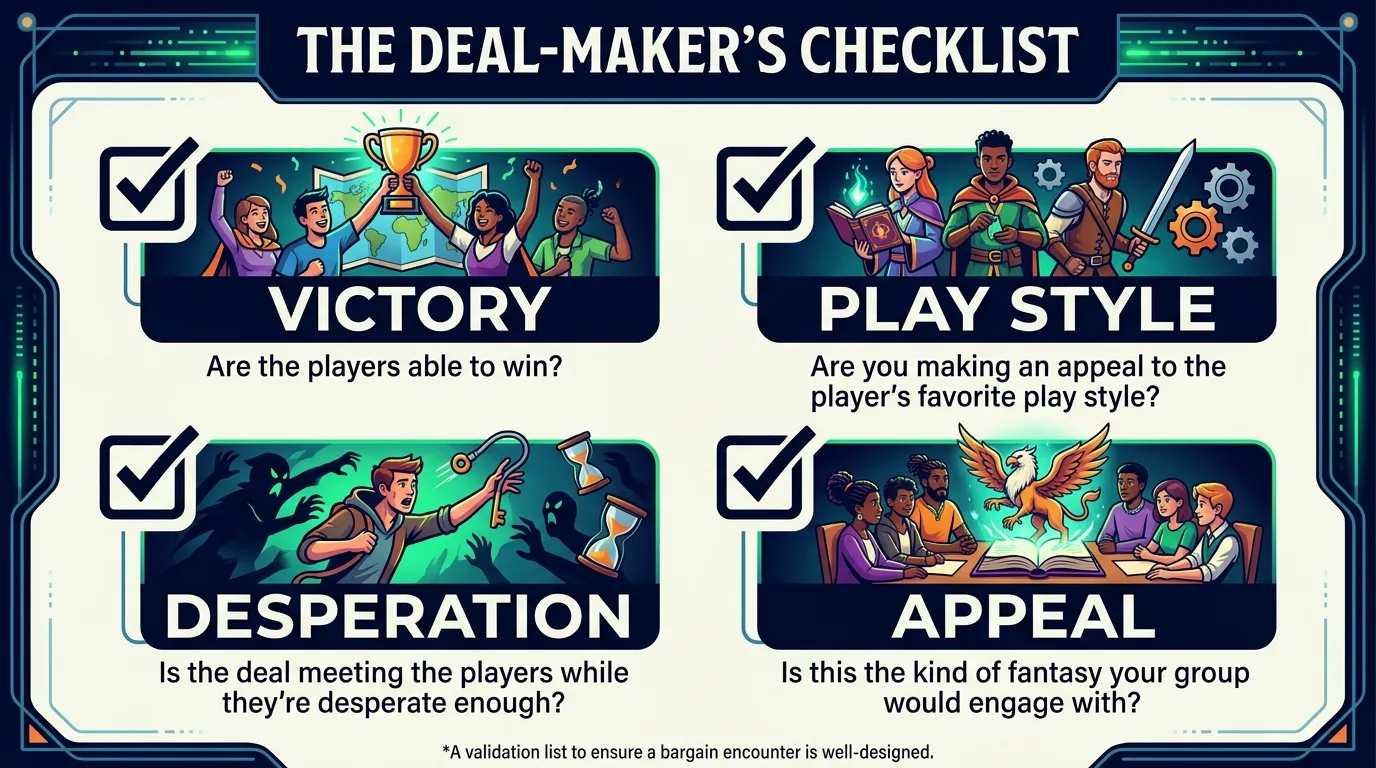
GM Checklist: Evaluating a Bargain
Before presenting the deal at the table, ask yourself these four questions:
- Victory: Is there a clear path for players to "win" or weasel out (even if it involves a deadly fight)?
- Play Style: Does the reward appeal specifically to what that player enjoys (e.g., a power gamer gets a power item)?
- Desperation: Are the players currently desperate enough to consider a risky trade?
- Appeal: Is this "fairy logic" or "moral grey area" something the group actually finds fun?
Common Mistakes
- Punishing immediately: If the consequence is felt the same moment as the reward, players will almost always say no.
- Forcing "Lessons": Avoid being a "teacher" who punishes players for "bad" decisions. Focus on making the conflict exciting.
- Lack of Agency: Don't write the bargain in stone. Allow players to renegotiate or find loopholes.
Infographics
The DM Style Political Compass
The Player Psychology Compass
D&D Player Types Quick-Reference
The Two Phases of a Fay Bargain
The Deal-Maker’s Checklist
Links from description
- [Pocket Bard App](https://www.pocketbard.app/?shortlink=MYSTIC-ARTS&c=Mystic_Arts_04_26&pid=Mystic Arts&af_xp=referral&source_caller=ui): Audio and soundscape app for GMs.
- Monster Week YouTube Channel: Community creator event.
- Fey Week Playlist: Collection of videos about the Fae.
- Playing at the World Blog: History of player typologies.
- Mystic Arts Patreon: Support the creators and get the CR20+ Archfey PDF.