Transcript
Hello. Self-contained adventures designed to be completed in a single session. You're playing a fun little one session long D and D oneshot. Itching to have a good time. And then it happens. Players derail it instantly. Parts you thought were going to take 30 minutes take 2 hours. The session ends. Your one shot is looking like a threeshot now. And everyone is too busy to come back for part two. Well, we're going to fix that today. I'm going to give you a method to make one shots that works. And I'm going to prove it by making a whole oneshot with you in this video that you can take home right now. Sounds good? Good. Because that's the video you're watching. I'm Anton Deiko. This is Pointy Hat and welcome to Tip of the Hat. The oneshot making video. Why do people even play oneshot? Campaigns let you delve into your blurbo's tragic backstory as much as your friends will let you monologue. NPCs and campaigns get to be much more fleshed out. You get to explore your build and all its shiny new toys much more when the game goes on for longer. What's the point of a oneshot? Well, because it's short. Testing a new player before adding them to your main group of guys. Trying a new set of rules or a new system out. Taking a new character build for a drive to see if you do end up getting that car. I mean, artificer, this is a different panel than I've had. Everything's computer. taking a break from the main campaign so that the type A control freak that has set up camp on what they refer to as peaceful occupation of the DMC for two decades now can take a mandatory break against their will. All are valid reasons to play a OneShot. So what is the through light here? That's right, it's their size. Don't make that weird. A one shot's biggest asset is that it's short. It's not the massive commitment of a campaign and it's not the still decently girthy commitment of a one to two monthl long adventure. Oh god, I made it weird. So, you can see why it's a problem when the one shot becomes a seven shot when the only reason you went for it is because it was teacup sized. Like those people that don't get that animals are little when they're babies and then they grow up good. We know why we play oneshots. So, what makes them good? Well, this is the most important part of this video and my method for making one shot. Everything else on this video hinges on this, including that one shot we're making. So, listen up, little boy, because this will be on the test. I'm doing this how else with a numbered list. I keep telling you all those Buzzfeed freaks really were on to something. Here's how to make a good oneshot. Number one, hello, my name is I don't care. You know what you don't need in a oneshot? An hourong tavern introduction scene. You don't need to waste time for the bar to ask if they can play a song to get two copper. You don't need the rogue to bring the scene to a screeching halt by refusing to engage with a party as they sit in the darkest corner of the tavern with their hood up. You don't need to give the person that made the cookie character yet another chance to act kooky and silly. They'll have plenty of that throughout the game. You're playing a one shot. Great. The players have met before. I like to keep it in between an hour and a day ago. That gives you just enough for the characters to know the basics like name, class, and general vibe beforehand. Just spend 5 minutes asking the players to introduce who their character is and describe them out of character. And you're good to go. You have a limited amount of time to play this, and you want to spend that time actually playing, not role- playinging. A company mixer. Ditto for questing. I'm a massive fan of oneshots that start when the players already have accepted the quest because that means you can describe what the quest is out of character in half the time it would take an NPC to do it and the players know exactly what the point of the oneshot is from the get. Which brings me to number two. Railroad this to hell and back. I need you to give up the ghost on this one real fast. You can have a linear or nonlinear oneshot. And if you want a one-shot with a beginning in the beginning, a middle, and an end in one session, you're going to have to accept that sandbox is just not the right story shape for this format. It just isn't. You can fight me on this. I'm right. And if you want to fight me, then fight me. Now, I'm using railroading wrong here. Like the wrong word. I use the word railroading here in that weird way the internet does where railroading means linear or nonlinear narrative and not deciding for your players what they need to do. Check out my railroading video to learn more. I say this because my oneshot method is specifically designed to include a ton of choices for your players to make. Linear oneshots and nonlinear ones can feature player choice. And as a matter of fact, I find it's quite easy to do. But if you find your oneshots dragging on, not finishing in one session, maybe stop coming to the table and saying, "What do you guys want to play today?" Give linear and nonlinear a shot. Stop with the sandbox for oneshots. You can do it in campaigns. And that brings me straight to number three. We're all in this together. You know how the goal here is to finish in one session? That should be the goal of everyone at the table. If you're the DM watching this, the girl reading this, if you will, you should not approach a one shot like, "My goal is to make sure that everything goes perfectly and the one shot ends in a satisfying conclusion for everyone in the allotted time for maximum efficiency while your players sit at the table specifically with the goal of making that as difficult as possible." Let me state this clearly. It is not being a bad DM to start a one shot by saying the adventure today is about saving the princess. You'll have plenty of choices as to how to do it, if you want to do it in the end, and more, but that's the adventure today. I go so far as to say that if your DM comes to your table and tells you that that's the adventure, and you then decide that actually the adventure today is [ __ ] around in the direction opposite to the tower where the princess is and see what the DM can improv, you are a bad player and nobody likes you. Ditto. If your character wouldn't save the princess, guess what? Make a character that would. I'm getting heated. Okay, look. Dn D is about choice. But it's about choice within a framework. And that framework needs to be tighter if you're playing a oneshot session with a beginning, a middle, and an end that fits in one session. So don't be afraid to lay down what the oneshot is at the start, or hell, the moment you propose the oneshot to your friends. Listen, there's no guide in God's green internet that can prevent a player that has decided it's their goal today to derail the oneshot from ruining that experience. I have only one tip to help you with that. Don't play with that idiot. The whole table must understand that the goal here is to play a self-contained one session adventure. Everyone's experience will dramatically improve when that happens. And once you have that, number four, embrace modularity. Okay, we're getting juicy now. Get ready. This is the most important piece of advice in this video and what everything else relies on. Make your one shot modular. Modular. You're going to be modular. You've prepared four encounters, but the players took 3 hours on the first two, and you only have 1 hour left. Guess what? We're skipping right to the end. We're doing the boss battle next, and we can because the oneshot was written with modularity in mind. It's more important to finish the oneshot in one session than to play every combat, puzzle, exploration, loot thing. I often write oneshots that I don't intend to run in full because I put so many choices in them. But I write them with modularity baked into them. That means plenty of encounter, most of them are easy to take out or change to take less time. This is the key to my method of oneshot baking and we're going to put it to work in my example. Once again, this will be on the test, so keep it in mind or you will find my ruler on your wrist, you naughty boy. We have our rules as to how to ensure that the oneshot goes swimmingly, but we don't have rules on one shot making, like a step-by-step guide. But what channel would this be if I just send you off to write a whole one shot on your own without that? You might have heard all the previous tips worded differently, but what we're doing now is different. We're making a method to help you make your own. And I'm putting it to the test by making a whole one shot using that method. And you can take that one shot home for profit, you ask? Of course not. You don't know yet? I'm stupid. I did all of this for charity. Yep. Made a whole one shot, added new rules, sketch stuff, paid for layout, did everything. And I'm donating every single scent to charity. But you're not even ready yet. It has a whole ass diabolist cleric subclass and a butler origin like a butler background devil summoner cleric combat butler. I needed to give the players in the audience something. And I didn't take a sponsorship this time to focus on this. So no money from that either. Just oh god stupid times 100. Why? Because it's June, the month where I am at my most powerful. It's the month of the prideful. All proceeds are donated to the Trevor Project. Yes, 100% of the proceeds. Oh, I'm losing money on this. I like to do charity. I think it's important. So, I want to make it a thing. A thing I do every year for the prideful time. I wanted to make this a cause that is personal to me. And, you know, we established that last year can't come out every year. So, we're doing this. But enough of that yapping. What is this method and what is the oneshot example? I call it the pointy hat modular method for oneshots or the MMOs. I just feel like that acronym has just never been used before. And I'll walk you through it. And by me, I mean I mean my human familiar. I'm tired of writing familiar. Human familiar. Be who you are. Be who you are for your praise. Okay, so this is pointy at no one should be surprised by this step. It's so baseline to this channel that I didn't even include it in the dock attached to this video. Pick a theme. Pick a theme to base your oneshot around. Or don't. I'm not the boss of you, but it does help a whole lot. So, what vibe should we pick for our oneshot? Well, I'm thinking fiends. I know, surprising. Okay, you know, I just really like him and I want to do it, so I'm going to do it. Okay, we have our visual theme. I don't want to spend more time on this. You can pick your own or I can pick for you clouds. Let's go to pointy hats modular method for oneshots. Okay, so we're going to think about our oneshot as a road that forks depending on the choices of the players. And so the first step on that road is to decide what our quest is. What is this oneshot going to be? Is it going to be a rescue mission? Is it going to be an infiltration mission? Is it going to be some kind of test to prove something? Choose what this quest is. Just imagine you're in a video game and you have to write a quest that a player would do. What is that quest? That will be your one shot. For our example, I kind of like the idea of a rescue mission. I haven't written that on the channel before, but I've run it a bunch and it's always fun. Since our one shot is fiends, it's very clear where we're going. We're saving someone from a fiend. And I like devils the most. They are the coolest ones. So, we're saving someone from a devil. The pantomime king. No, not the pandemime. That's a different pointy hat video. Just made it extra confusing for you. The pantoime king is a devil that spends most of his time in the material realm. Because in the material realm, they are powerful enough to subjugate mortals to their will and establish a court, like a king's court. Phantom kings are actually deeply jealous of arch devils, the princes of hell. And so they travel to the material realm to basically lar as one of them, one of the arch devils. Their thing is that they are obsessed with the mortal concept of nobility, like as mortals understand nobility. So when they get to the material realm, they find a ruin of a castle and establish their court there, or at least start. And every court needs courters. So they put people that have made the very dumb mistake of existing close to this court under a very powerful enchantment. This enchantment forces these people to act as the pantoime king's courters, like the people that worship him as a king. Imagine these hellish waltzes and ruined throne rooms filled with people enchanted to dance until they drop dead so that this whole devil gets to feel important. I love it. I couldn't think of something more me. Our quest is going to be saving one of these people. Our quest giver Luan is a waning moon bishop for a cult of the moon. He was on a pilgrimage with his partner and guardian Demian when they decided to rest for the night in the ruins of a castle. And of course, they didn't know that a pantoime king had made of that castle his layer for laring purposes. Luan managed to evade the Luan managed to evade the Luan managed to evade the charm effect because he's an elf but and Demian the human wasn't so lucky. So Luan hires the players Hu to go to the highest tower of Kusha Castle and free his partner and Demian. Also tip of the hat I guess here it's also really good and really handy to have an NPC to kind of guide your players especially in a oneshot so like it doesn't spin out of control and go like somewhere you really don't want it to go. NPCs are also good to add roleplay to a oneshot, which I think that a lot of people just ignore. And I think that that's a mistake. Some people's favorite part of the game is roleplay, which is why this oneshot has that companion system to it. Yes, a whole system. It's designed so you can take NPCs with you and they can affect combat, but just a little bit like they cannot overshadow players. So Luan will tag along with a party and actually help them out. Like he can do things with his companion actions. What I like about this is that it makes Luan like a presence in this one shot and you kind of like feel for him and his plight, but also he doesn't turn into those DMPCs that I hate so much. Flames on the side of my face. Okay, cool. So, we started to go down our little path of modular method of oneshot making. We have chosen our quest. We know the general shape of our oneshot, like the goal, which is rescue mission. What next? Well, we're going to introduce choice, a fork in the path. I'm making sure that I pronounce fork correctly because that's an easy word to mispronounce. In this method of modular method of one shotmaking, there's two paths. The path of least resistance and the path least traveled on. The path of least resistance is the easiest path to get to the end of the adventure. It's also the most obvious path to get there. The path least traveled on is either out of the way or seems harder, but it gives the player a key. And the key thing is very important in this method. What is a key? A key could be anything. It could be a literal key. It could be information to approach the rest of the oneshot. It could be anything that unlocks further choices later on in the story. That's why it's a key cuz it unlocks choices. I'm very smart. This is here to reward exploration, but also I can tell you from running this a thousand times that people generally like 99% of the time go path least traveled on every single time because you don't want to miss out on stuff. And that's by design. It's honestly a better path, but you need to have the choice there to make it feel like a choice. Sometimes choice cannot be fake. Sometimes choice can be faked and sometimes it can't. Sometimes people can tell that you're not giving them a real choice. I can tell when DMs do it wrong. Okay. So, you can really understand what I mean with pathies traveled on and path of least resistance. Yeah, that's correct. I'm very smart. So, what is the truth? I'm going to outline both of those for the one shot we're making right now in this video together, you and I. Well, okay. What if on their way to Kusha Castle, they find someone that has also lost someone else to the pantoine king. A mom has lost her up thief of a daughter. Her name is Gane. Got to add a girl failure to the one shot for it to work. It's also on the method. You You have to have a girl failure otherwise the one shot will be bad. Gane went into the castle and said that she would stick to the lower floors and like kind of steal everything from there without being seen by the devil. And guess what? She has not returned. You know, great plan though. But Luan wants to go up the tower immediately to save Endmian. And that's our fork in the road that leads to the two paths. Food. See, boy's got to eat. Luan pressures the party to go directly up the tower because one, he has a very hard time within Demian's mortality as an elf. Like he's like, "Oh god, he's going to last for 5 minutes and I've lost three to this devil already." And two, he believes that whatever happened with Gane will be solved by just killing the pantoine king. So there's no point in going down and see what's wrong with her. So that is the path of Lee's resistance. It is the easiest path to finish the quest. But the path le traveled on is to go see what's up with Gane. Okay, you get it. One path is straightforward, one path is more tortuous, but they both get to the same point. This super simple strategy makes it both so that one shots feel like player choice matters, but also it makes it so that you can actually fit it in one session and not like three one sessions. So what comes next? Well, the bulk of the one shot comes next. This is the part that counts. The encounters get it counts. Be who you are. Remember the whole embrace modularity. Here's where it counts again. Listen to this. The most important part of this method is to make encounters modular. What does that mean? It means that you need to design them so they're easy to take out completely. Just throw them away and keep going or replace them with a thing that will take way less time. I generally advise to either go two combat encounters, one roleplay encounter, and one exploration encounter if you tend to go through games fast, or if you don't, because your players keep talking about their feelings, you do two combat encounters and either one roleplay or a puzzle, not more. But with this method, you can make more. And in the example adventure, I made more because you can take as many as you want out or most of them out. I'm going to give you an example. There's a stealth section. Like lit I'm so proud of this literal stealth section like in a video game like cones of light. There's just these maids cleaning a library, right? You have to like maneuver around the library without stepping into the cones of light. The adventure comes with like a diagram so you can play this. This section can be taken out completely. There's loot in it and everything. You can just place the loot directly after the library is empty. There's less mates. You can do whatever to make this shorter or completely eliminate it. So, the only thing you do while you run is check time. I generally advise for every encounter to count 1 hour. And if you have more time, that's great. Maybe you give some time for the players to talk to each other. But generally, it's always good to think of every encounter as lasting 1 hour. In this same one, there's also an encounter with the Chhattelin of the castle. This is the guy that like oversees the other devils that work for the pantoime king to really really drive home the fact that he is a pantomime king. Like he has servants. Like you're literally fighting the hellish version of the noble castle like evil beauty and the beast. I think that that's cool. Anyway, this encounter you can also take off modularity. I like to give one encounter to the path least traveled on. One encounter that can only happen there. So in this one, let's say that gane is in those dungeons and the lock that is holding her prisoner is a devil. A devil is a lock. And in the fight, if you cast knock on the walking lock or you use thieves tools on it, it takes damage. And like in the actual oneot, it's written how much damage it should take. I think that that's funny and that's cool. And this encounter is also modular. It can also be taken out. If the players do take this path and they free Gane, she'll explain what she's actually doing here and how she survived the enchantment thing cuz she's also human. And I'm not going to spoil it here because maybe you want to play it. It's certainly interesting. Okay, so we have made it through encounters and now we are at the showdown. And because we made all of our encounters with modularity in mind, we have time to spare, right? This is just the climax of your one shot. Don't make that weird. It could be a boss battle. That's the most normal one. And don't feel bad. The example here is a boss battle. I love boss battles. But it could also be a very tense roleplay encounter. There's some of that, too, in the one shot. It could also be an escape from like a crumbling temple or something like in Boulders's Gate with the sun thing. Be creative. If you've run like seven boss battles and you're like, "Oh, I want to spice it up." A showdown will really drive the point home of like, wow, this feels different. For our example, the showdown is what else? The walts against the pantoime king. I think that that's fun, but I would. The pantoime king can like summon people of its court to help him. He can also summon devils. Like a literal trumpet sounds, and a devil comes in, and they're named, let me read you the names. They're fun. The Duke of Dread, the Earl of Infeeblement, the Patrician of Poxy. Of course, the Pentamine King can enchant the players. But guess what? I also made like a tiny system called difference here. Yes, it's in the one shot. Basically, every time you rest in the castle, you can acrue difference. And the more difference you acrew, the harder it is to resist the king. Like what happened to Admian. I like when like storytelling and mechanics go hand in hand. And I think that that's cool. And the key for your showdown is choice. Depending on the choices that have happened before, you need to make it so the showdown either changes or whatever happens directly after the showdown changes. And this is the easiest part. I know it sounds complicated, but no, it is the easiest because it's the end of the one shot. You don't need to like make sure that something happens after the final choice because it's over. The one shot is done. You finished it. You can make the most insane consequence of that choice. It's a one-shot. It just needs to feel like the player's choices mattered. And here it is. They matter. In our example, the pantoime king gives Luan a choice he like cannot refuse. But here's the thing. Is gane here? What happened in the dungeons where she was being kept? Were your players nice to Luan? Did they empathize with him? or did they have like a sort of adversarial relationship because he refused to help Gane? All of those choices matter here at the end. It's the showdown and you need to make the showdown the place where choices matter the most. And with this method, yes, the adventure is linear, but because we limited choice, choice still happens, but it's manageable. And because we kept every encounter modular, we get to see the conclusion of those choices. Score. Yeah, but what about a whole cleric subtask based on summoning fiends to bend them to your holy will? based on the RS Goisha and that funky little bird demon. What about a butler background with its own feet that lets you play a combat butler? Also, what did the players find in the dungeons where Gane was? Why was Gane in the castle in the first place? What happens if you help her? How does the end change? What options does the key unlock? Well, go find the answer to that now. The Pantoman King, the first of the Pridefolios, is for you to claim this Pride season. It includes the whole Pantom King adventures, which is 16,000 words. Yes, that many. A cleric diabolis subclass and a butler origin. All proceeds, yes, I repeat, all proceeds go to charity. Each and every single scent. To make it clear, everyone that worked on this adventure got paid by me except for me, I guess. But I get AdSense. It's fine. They won't cover it. And I didn't take a sponsorship for this. It's fine. It's fine. And I worked with some incredible artists. One of them being Diana Franco. You might not know her by name, but this meme, this was drawn by her. And look at the subclass art that Inky J drew and the portraits. Look. And it's a PDF. So, if you buy it now, you get it now. Immediately. Go grab it if you want to. But did you really think that you were going to walk away from a pony hat video without a completely free thing? Of course not. Even if it's for charity, I want to keep true to the soul of the channel. So, instead of having you re-watch this video a thousand times trying to use it, the modular method for oneshots is for you to grab written by me with examples and helpful tips for 100% certified pointy hatree. So, you can make your own stuff. Real talk, as an LG TV myself, I was terrified to come out last year. And like 90% of you were completely normal and very supportive about it, which rocked. I was legit scared I was going to lose a portion of my audience. Probably I did, but I didn't notice. And since I've been so lucky and the channel has grown so much, it felt important to give back and go allin on charity this year. I hope we can raise something for charity and if you like it, I would love to make more Pridefolios every single year with adventures and other stuff. Maybe something like playerf facing next time. The pantomime king is exactly what I want out of something like this. It's not an adventure about being LGTV or whatever. It's a cool adventure that just happens to feature queer characters and those characters get to be real characters with flaws and strengths. That's what I want and wanted out of representation for so long and I get to do that because you guys are here. I didn't want some pandering save the pride parade adventure thing. So, I hope you all like it. All right, consider donating by grabbing that whole PDF. And if you want a whole free adventure, here's my Kraken Wig video. And when we get to 500K, and it's getting scarily close, I'll do something for free. Don't worry. All right. Happy Pride. Go check out the Kraken video if you want. Thank you all for being so cool. See you. Bye-bye. [Music] Haven't watched that in years. Something possessed me. A very scary thing possessed
This video introduces the Modular Method for One-Shots (MMO), a framework designed to ensure D&D one-shots actually finish in a single session while still allowing for meaningful player choices. It provides a step-by-step design process, advice for table management, and a complete example adventure (The Pantomime King) to illustrate the method.
Why Run a One-Shot?
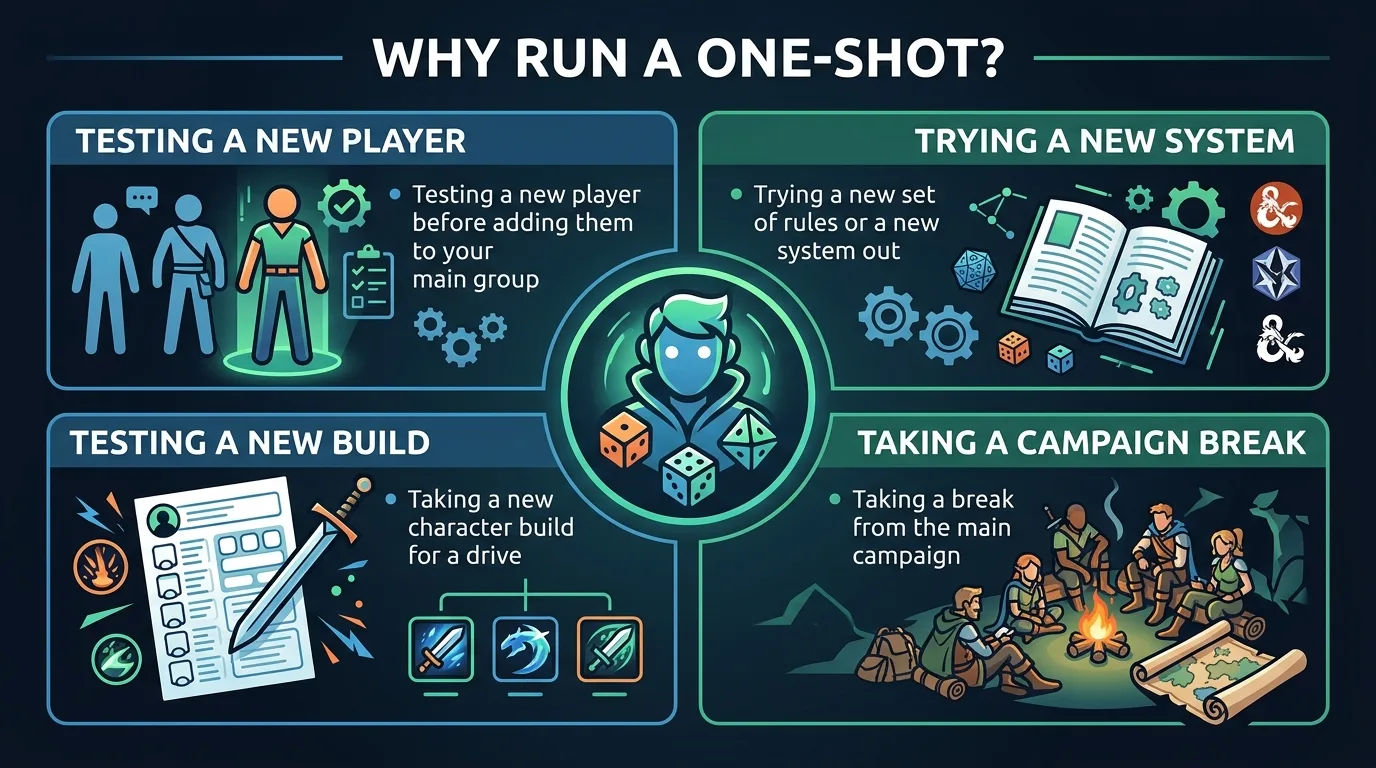
One-shots are unique tools for a gaming group, serving several distinct purposes beyond just "a shorter game":
The 4 Pillars of a Successful One-Shot
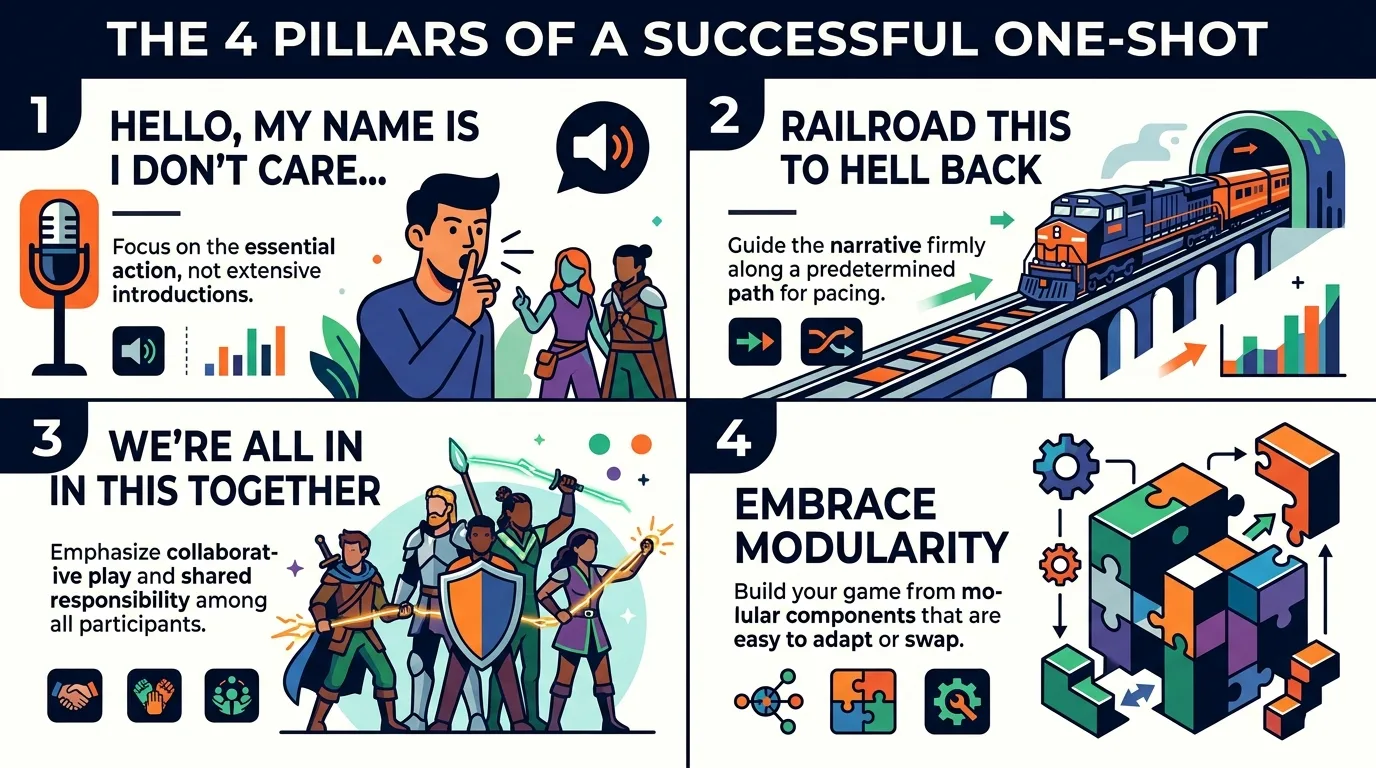
To ensure a one-shot stays on track, follow these core principles:
- Skip the Tavern: Stop wasting the first hour on introductions and "meeting in a bar." Start after the players have already met and accepted the quest.
- Linear Design: Abandon the "sandbox" for one-shots. You need a beginning, middle, and end that fits in 4 hours. You can have choices within a linear framework, but you cannot have an open world.
- Shared Goals: The players and GM must all agree that the goal is to finish the story tonight.
- Embrace Modularity: Design encounters that can be easily removed if the session is running long. It is more important to reach the finale than to play every single battle you prepped.
The Pointy Hat Modular Method (MMO) Flow
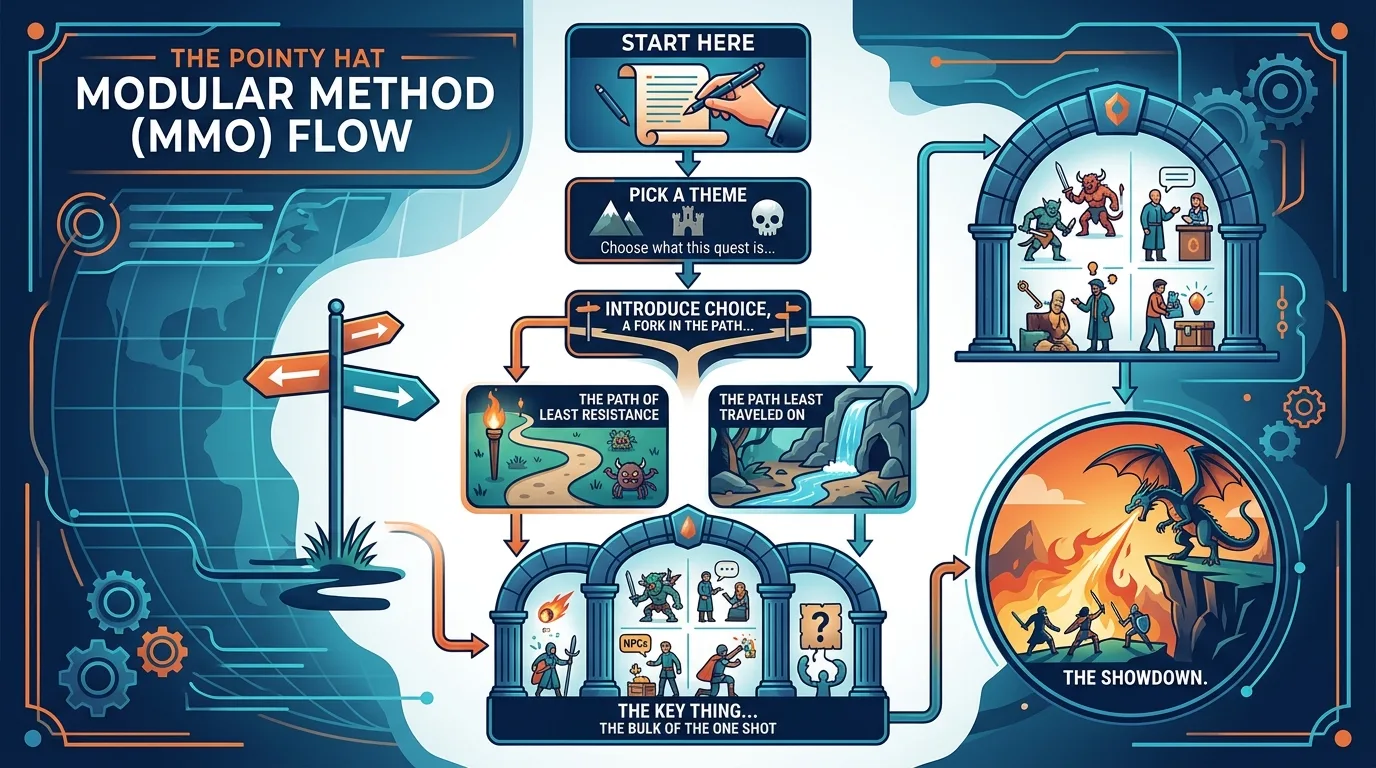
Step 0: Above the Table (Prep)
Before dice hit the table, handle the "time sinks" out-of-character:
Step 1: The Inciting Quest
Start the game at the location of the adventure, not the quest-giver's office.
Step 2 & 3: Two Paths and The Key
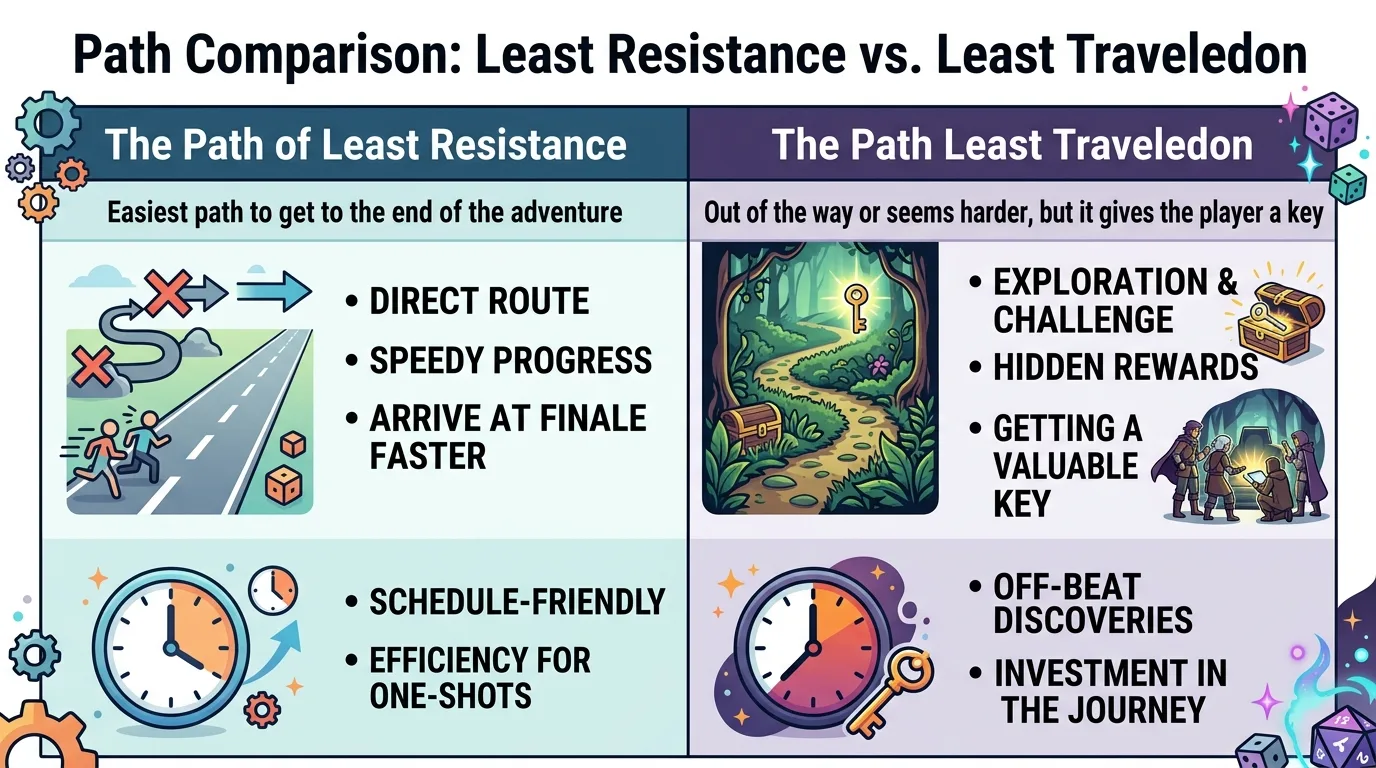
Instead of a sandbox, offer exactly two directions:
- The Path of Least Resistance: The most obvious, direct route to the boss/goal.
- The Path Least Traveled On: A harder or out-of-the-way route that offers a Key.
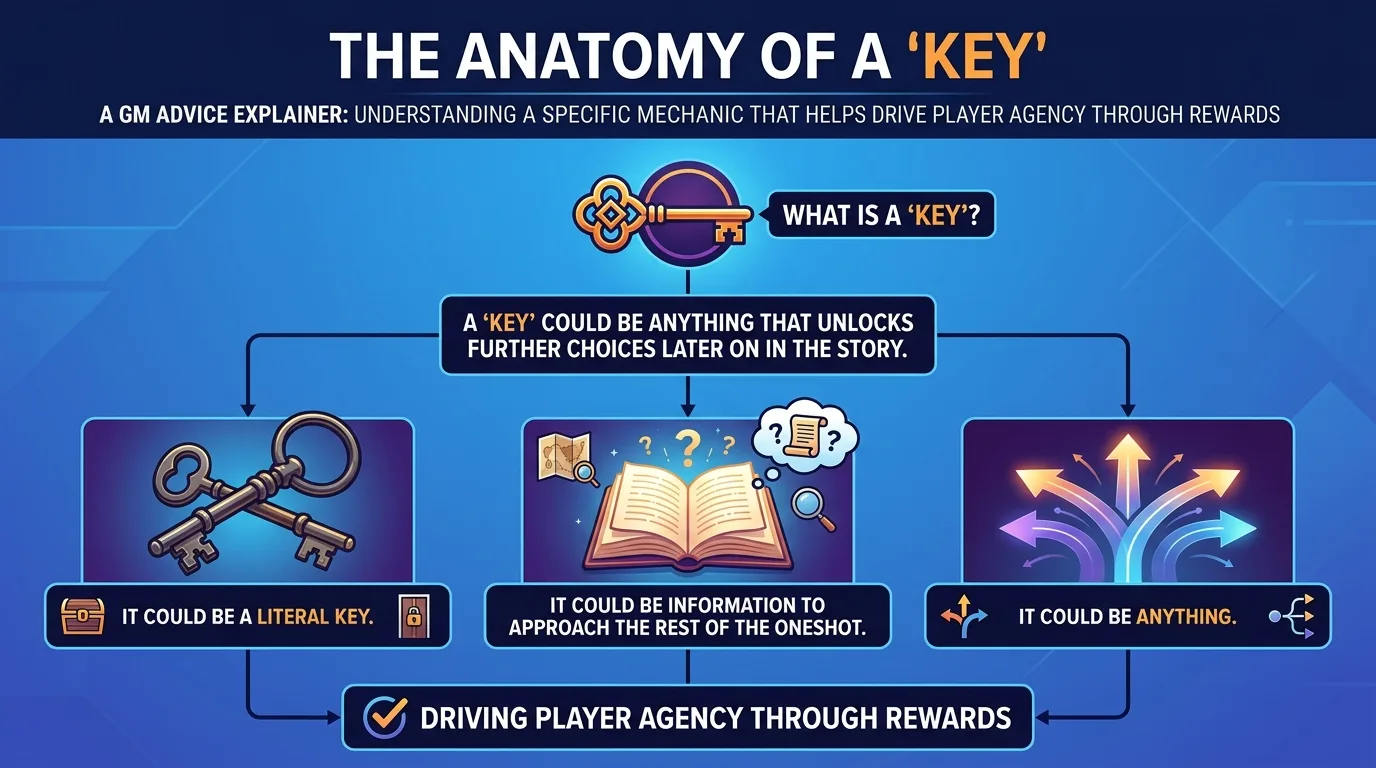
A Key is any resource—a literal key, a secret, or a piece of lore—that unlocks a different or better ending.
- Key Examples: Learning that the Quest Giver is actually the villain; finding a secret weakness of the boss; discovering a way to save an NPC who would otherwise die.
Step 4: Modular Encounters
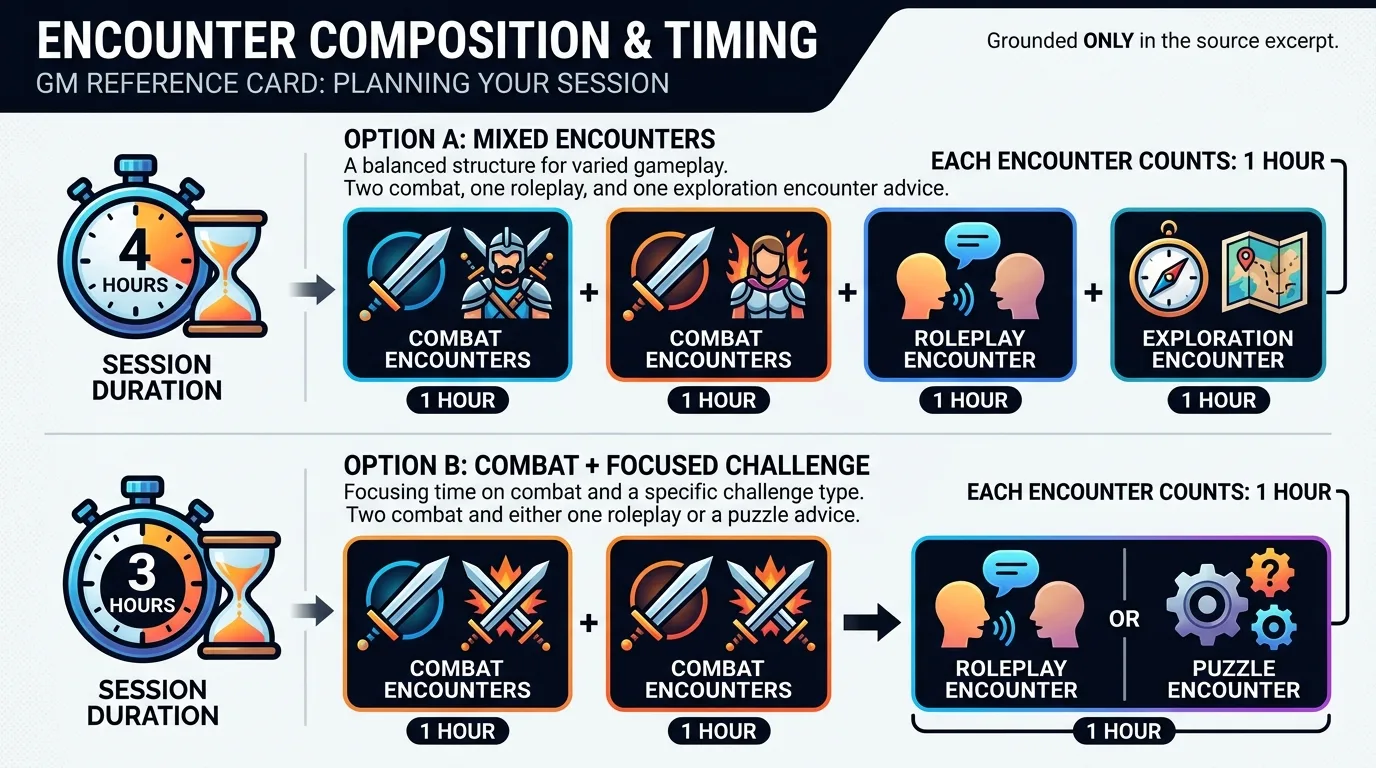
Design your encounters as independent modules. If you are 3 hours into a 4-hour slot and haven't reached the boss, cut the next encounter immediately.
Standard One-Shot Budget:
The "1-Hour Rule": Budget 60 minutes per encounter. If you fall behind, skip to Step 5.
Step 5: The Showdown & Endings
The only non-modular part of the session. It should be the climax of the story.
GM Checklist: Designing Your MMO
Player Checklist: The One-Shot Mindset
Related Resources
- The Modular Method for One-Shots (Full Doc): The speaker provides a public Google Doc containing the full framework, including additional examples of quests, keys, and encounter types.
- The Pantomime King Pride Folio: A 16,000-word adventure designed using this method. It includes a companion system for NPCs, the "Diabolist" Cleric subclass, and the "Butler" background. All proceeds go to The Trevor Project.